01
Keep it cool
60–68°F is the comfort zone. Above 72°F they stress and get sick — a fan or chiller may be needed in summer. No heater.
Freshwater · Coldwater amphibian
Seven golden rules for a happy axolotl.
60–68°F is the comfort zone. Above 72°F they stress and get sick — a fan or chiller may be needed in summer. No heater.
Axolotls inhale food with suction and can swallow gravel. Use bare bottom, very fine sand, or stones larger than their head.
Feathery gills are delicate. A sponge filter or baffled outflow keeps water clean without pushing them around.
Fish nip gills, and axolotls swallow anything that fits in their mouth. Keep them with other axolotls of similar size only.
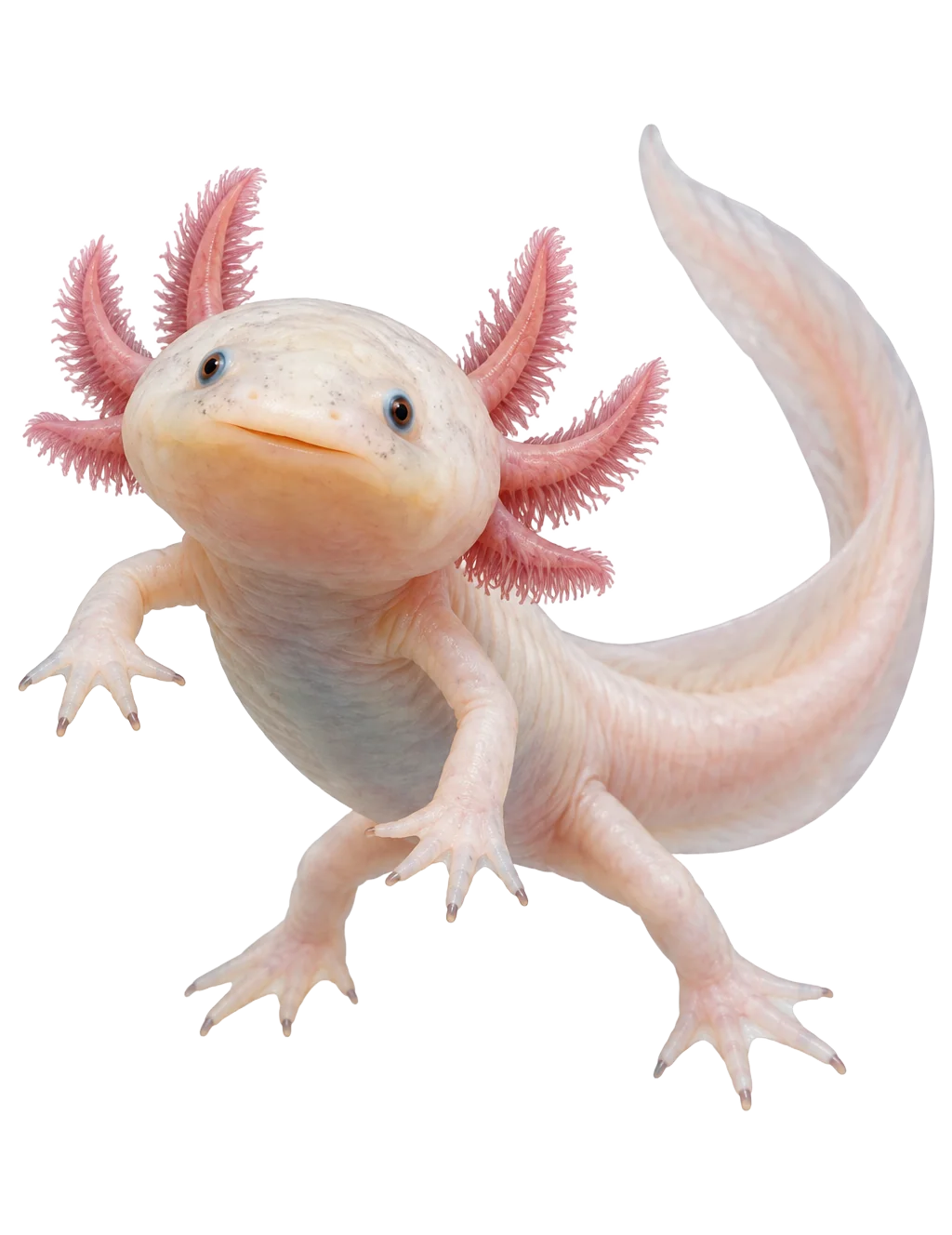
Not a fish. Not tropical.
A Mexican salamander that never leaves the water — and needs a cool, calm tank of its own.
Establish the filter before adding an axolotl. Test the water regularly and keep ammonia and nitrite at zero.
Axolotls have no eyelids. Keep lighting dim and provide smooth caves or plant cover where they can retreat.
Their skin and gills are delicate. Avoid picking them up; use a suitable container when a move is necessary.
02 / Water
03 / Everyday care
A 20-gallon long is the minimum for one adult; 29–40 gallon breeder tanks give room for growth. Adults reach 9–12 inches.
Earthworms are the staple, plus sinking carnivore pellets. Juveniles eat daily; adults every 2–3 days.
They have no eyelids and prefer dim light. Provide caves, plants or shade so they can hide.
Use a secure lid. Avoid handling — their skin is soft and their bones are mostly cartilage.
Change 20–30% weekly with dechlorinated, temperature-matched water. Cycle the tank fully first.
Gills curled forward, floating, cloudy patches or refusing food usually mean water is too warm or dirty. Bring a sample in.
04 / Morphs
Pale pink-white body, deep red gills and dark eyes — the classic look.
Mottled dark olive-brown with gold flecks; often the hardiest-looking.
Warm yellow-gold body with peach gills and light eyes; sensitive to bright light.
Caramel-brown body with darker freckles and reddish eyes.
Solid dark charcoal to black, with no shiny gold flecks.
All white with pink gills and pink-red eyes; prefers dim lighting.
Morphs shown for reference; availability varies.
Ask us about current availability, cooling options and a setup that suits your space.